







5.0
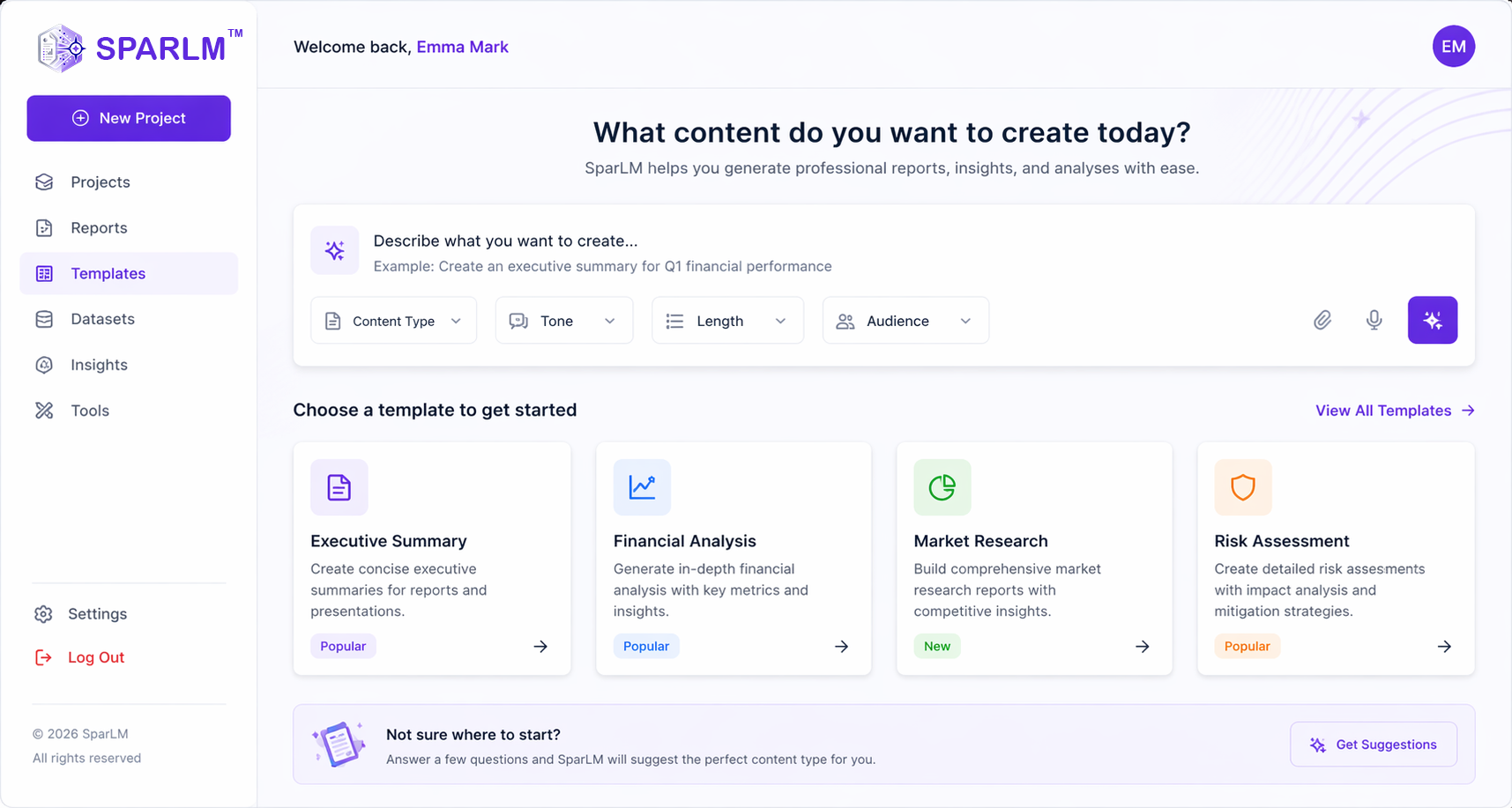
Designed for teams that need evidence-backed decisions






Features
Analyze Complex Documents and Generate Decision-Ready Insight.
Go beyond summaries with SPARLM™ - extract evidence, detect gaps, challenge assumptions, and create structured reports in minutes.
Document Intelligence Tools
Process PDFs, decks, transcripts, and reports with AI built to preserve structure, context, and evidence.

Analytical Reasoning Engine
Move from raw information to validated insights with sparring, gap detection, and evidence-backed reasoning.
Evidence Chains
Missing Gaps
Contradictions
Insight Signals
Reasoning Flow
Decision Reports

Automated Analysis
Read long documents, extract evidence, detect gaps, and turn complex information into structured insight.

Hi SparLM! Help me analyze this report


Evidence-Backed Reports
Generate structured reports with citations, reasoning flow, and traceable evidence your team can defend.
Sparring Templates Library
Use ready-made analytical flows for finance, pharma, risk, research, and compliance review.
Integrations
Power Up Your Analysis with AI Integrations.
Connect SPARLM™ with enterprise documents, knowledge systems, and workflow tools to turn scattered information into trusted, decision-ready insight.



Smart Analysis
Flexible Analysis Templates with Complete Reasoning Workflows.
Create structured, evidence-backed outputs using analytical templates that adapt to your domain, documents, and decision needs.

Literature Review Brief
Summarize research papers, compare findings, and surface evidence gaps with clear analytical structure.
Market Landscape Report
Turn market reports, decks, and notes into structured insights on trends, players, risks, and signals.
Evidence Synthesis
Combine multiple sources into one clear view of claims, proof, contradictions, and open questions.
Concept Map Builder
Identify key concepts, relationships, assumptions, and knowledge gaps across complex research material.
Novel Insight Finder
Detect hidden patterns, weak signals, unusual findings, and non-obvious implications inside documents.
Executive Research Summary
Convert dense research into leadership-ready briefs with findings, risks, evidence, and next actions.
Risk Assessment Brief
Identify key risks, missing controls, weak assumptions, and unresolved decision points from documents.
Compliance Gap Review
Compare policies, reports, and evidence to detect missing information, contradictions, and audit gaps.
Control Evidence Mapping
Map every control, claim, and compliance statement to supporting evidence and source references.
Incident Review Summary
Convert incident notes and RCA inputs into structured findings, causes, actions, and risk signals.
Audit Readiness Report
Generate traceable summaries with evidence chains, open questions, and areas needing human review.
Policy Contradiction Check
Detect conflicting statements across policy documents, memos, reports, and operating procedures.
Investment Memo Outline
Build investment memos with thesis, market view, assumptions, risks, evidence, and decision logic.
Financial Report Analysis
Analyze filings, annual reports, and decks to surface drivers, risks, inconsistencies, and missing context.
Portfolio Review Brief
Summarize portfolio updates, performance signals, exposure risks, and decision points for review meetings.
Due Diligence Summary
Convert diligence documents into clear findings across business model, financials, risks, and red flags.
Valuation Notes Builder
Organize valuation assumptions, comparable signals, uncertainty areas, and supporting evidence clearly.
Investor Update Digest
Turn investor decks, transcripts, and notes into concise updates with insights, concerns, and follow-ups.
Clinical Study Summary
Summarize study design, endpoints, outcomes, safety signals, limitations, and evidence references.
Regulatory Brief Builder
Convert regulatory documents into structured summaries with key claims, risks, and missing information.
Safety Signal Review
Identify adverse patterns, inconsistencies, reporting gaps, and follow-up questions from clinical material.
Protocol Gap Analysis
Review protocols for unclear criteria, missing assumptions, contradictory sections, and decision risks.
Evidence Review Matrix
Map clinical claims to source excerpts, endpoints, tables, and supporting or conflicting evidence.
Medical Writing Support
Turn complex clinical inputs into structured summaries, review briefs, and documentation-ready outputs.
Requirements to Tech Spec
Convert business requirements, notes, and transcripts into structured technical specifications.
Design Review Summary
Analyze architecture documents for dependencies, assumptions, contradictions, gaps, and risks.
QA Test Case Builder
Transform requirements and user stories into test scenarios, edge cases, and validation checkpoints.
Meeting Transcript Digest
Convert technical discussions into decisions, action items, risks, unresolved questions, and next steps.
Change Impact Review
Identify affected systems, dependencies, risk areas, and missing implementation details from change docs.
RCA Documentation Draft
Structure root-cause inputs into issue summary, contributing factors, evidence, actions, and prevention plan.


How SPARLM™ Works
See How SPARLM™ Turns Documents Into Decisions

Upload Documents
Add PDFs, decks, transcripts, reports, or notes for SPARLM™ to read, structure, and prepare for analysis.
01


Map Context & Goals
Define the domain, decision goal, review angle, and key questions SPARLM™ should reason through.
02

Spar & Analyze
SPARLM™ challenges assumptions, detects gaps, checks contradictions, and surfaces evidence-backed insights.
03

Export Decision Reports
Generate structured reports with citations, reasoning flow, evidence trails, and clear decision points.
04










SPARLM™ Testimonials
See What Analysts and Teams Say About SPARLM™.
SparLM helped our analysts turn scattered documents into clear reports with stronger evidence and faster review cycles.”

“We now review clinical papers, risk notes, and transcripts with more confidence, structure, and traceable insights.”

“SparLM reduced the time our team spent reading long reports and helped us focus on decisions that truly mattered.”

“The platform gave our compliance team clearer summaries, sharper gap checks, and evidence trails we could trust.”

“SparLM made research reviews more disciplined by surfacing missing assumptions, contradictions, and hidden signals.”

“Our team moved from manual document review to structured intelligence that supported faster investment decisions.”

“SparLM helped us convert complex technical notes into concise briefs that managers and engineers could act on.”

“We use SparLM to question assumptions, compare evidence, and create reports that feel ready for leadership review.”

Popular Questions
Questions on Your Mind? We’re Here to Help.
Find clear answers about SPARLM™ document reasoning, evidence mapping, sparring, and decision-ready reporting.
SPARLM™ is a Socratic & Analytical Reasoning Language Model that helps teams turn complex documents into validated insights, evidence chains, and decision-ready reports.
No. SPARLM™ goes beyond summarization by detecting gaps, contradictions, assumptions, risks, and hidden insights across documents.
SPARLM™ can work with PDFs, reports, decks, transcripts, meeting notes, research papers, clinical documents, risk memos, and technical documents.
It helps analysts upload documents, map context, spar with the AI, test assumptions, extract evidence, and generate structured reports faster.
Yes. SPARLM™ creates structured outputs with citations, reasoning flow, evidence trails, gaps, risks, and decision points for review.
SparLM is useful for research, finance, investment, pharma, clinical, risk, compliance, SDLC, product, and strategy teams.
Yes. SPARLM™ is designed to identify conflicting claims, missing context, weak arguments, and inconsistencies across one or multiple documents.



- Image
- SKU
- Rating
- Price
- Stock
- Availability
- Add to cart
- Description
- Content
- Weight
- Dimensions
- Additional information